## About The Pull Request

Removes the nukie base and wizard den from the base centcom map. They
are instead now lazy loaded as required.
To make a new lazy load template is fairly simple, make a map, allocate
an area for it, and place a marker at the bottom left corner of that
area. I have it check an area to ensure that if someone makes the map
larger than expected but doesn't account for the template allocation it
doesn't overwrite stuff without warning

[Replaces some improper CHECK_TICKs with
MAPLOADING_CHECK_TICKs](https://github.com/tgstation/tgstation/pull/71785/commits/c7fbca9148812b392dca76d5450fb6bb86716462)

Atom init has already been tripped by the time we get to this portion of
the loading, so if we don't use the right check tick, we will
potentially block unrelated init attempts. This is bad. (Lemon edit, I
want this in the commit desc)

## Why It's Good For The Game

Cuts down on init times.
Closes https://github.com/tgstation/dev-cycles-initiative/issues/17
## Changelog
🆑
admin: New mapping verb to load lazy templates as needed. In your admin
tab under the Mapping category.
/🆑
this isnt technically player visible, so not sure it needs a changelog

Co-authored-by: san7890 <the@san7890.com>
Co-authored-by: Mothblocks <35135081+Mothblocks@users.noreply.github.com>
Co-authored-by: LemonInTheDark <58055496+LemonInTheDark@users.noreply.github.com>
## About The Pull Request

[Saves 0.2 seconds of init time. 50% of emissive
blockers](https://github.com/tgstation/tgstation/commit/8318b648f6d32844aacbfb4c309152cd45801f5c)

Emissive blockers are a decent expense during init, even these, which
are the ones that update outside of initialize.
I've inlined them, removed some redundant vars and checks, reduced the
arg count, and shifted some things around. This ends up saving 200ms, or
50% of its total cost.

I also shifted mutable_appearance about a bit. it's not a massive
saving, but it is technically faster

[Prevents a few redundant appearance_updates, saves 0.8 seconds of
init](https://github.com/tgstation/tgstation/commit/5475cd778b66b22b1e2c8d86b2c6d59fb84f219a)

Prequisit info: update_appearance is decently expensive
It's good then to only do it if we have a reason to, right?

Me and moth were shooting the shit about just general init time, and we
came up with the idea of tracking which update_appearances actually
"worked" and which didn't.

That bit comes later, let's enjoy the fruits of that work first

First, holograms were calling update_appearance on process, for almost
no reason.
I patched the one event they don't already "react" to, and then locked
it behind a change decection if.
good for live, doesn't impact init.

Next, decals. If you add a decal to something before it inits, it'll
react to the after successful init signal.
The trouble is the same atom could have its appearance updated from this
MORE then once, since decals can be stacked on tiles, and signal
unregisters don't work once the signal is sent.
So we add a flag to track if we've had this happen to us or not, so it
only happens once.
saves 80 ms

Power! lots of things call power_change on init, often more then once.
We'll update appearance for each of those calls, even if only one is an
actual change.
That's silly, better to track what sort of power we're using for our
appearance and go off that changing

This was taking about 300ms. Really stupid

Icon smoothing. After emissive blockers were added, any change to
something's icon smoothing would lead to an update_appearance call.
Nasty shit, specially cause of walls, which don't even use emissive
blockers.
Ok then, so we'll always update appearance for movables, and will allow
turfs that are interested to hook it manually.
Not many of those anyhow
This is slightly a dev ux thing, but it saves 600ms so I think it's
worth it. Rare case anyway

Telecomms:
telecomm machines were updating appearance on process. This is to cover
for them turning on/off on process.
Better then to just check if on actually changed.
This cost adds up midgame, doesn't impact init tho

Materials:
There's this update_appearance call in material on_apply. it doesn't do
anything.
The logs will lie to you and say it does, but it's just like reapplying
emissives. It doesn't need to exist
Saves like 50ms

Canisters:
Live thing, lots of time wasted updating appearance for no reason, lets
see if we change anything first yes?

[Uses defines to wrap update_appearance for
tracking](https://github.com/tgstation/tgstation/commit/4fa82e1c9d93577aadb3c743f17196331f62e67c)

[Undoes _update_appearance changes, instead reccomends 2 regexes to
use](https://github.com/tgstation/tgstation/commit/a8c8fec57a4e43d1fa636b5ac68459903faa9fc5)

I need file and line number for my tracking, so I need to override
update_appearance calls, and also preferably not require every override
of update_appearance to handle dummy file + line args.

So instead, I created a wrapper proc that checks to see if appearanaces
match (they're unique remember, the two of the same visual appearance
will be equivalent)
The trouble is I can't intercept JUST proc calls, or JUST function
definitions with defines. it needs to be both.

So I renamed the /update_appearance proc to /_update_appearance

this way I can capture old uses, and don't need to worry about merge/dev
brain skew

~~It does mean that all update_appearance proc definitions now look
weird tho.
My profiling is leaking into dev ux. I wish I had better templating.~~

**The above is no longer being pr'd**, it's instead just recommended via
a few regexes adjacent to the define.
Smelled wrong anyhow

[Adds a setter for panel_open, so I can update_appearance on
it](https://github.com/tgstation/tgstation/pull/71658/commits/cf1df8a69fc1a816391d085ee7419b14f9fe9167)

## Why It's Good For The Game

Speed
## About The Pull Request
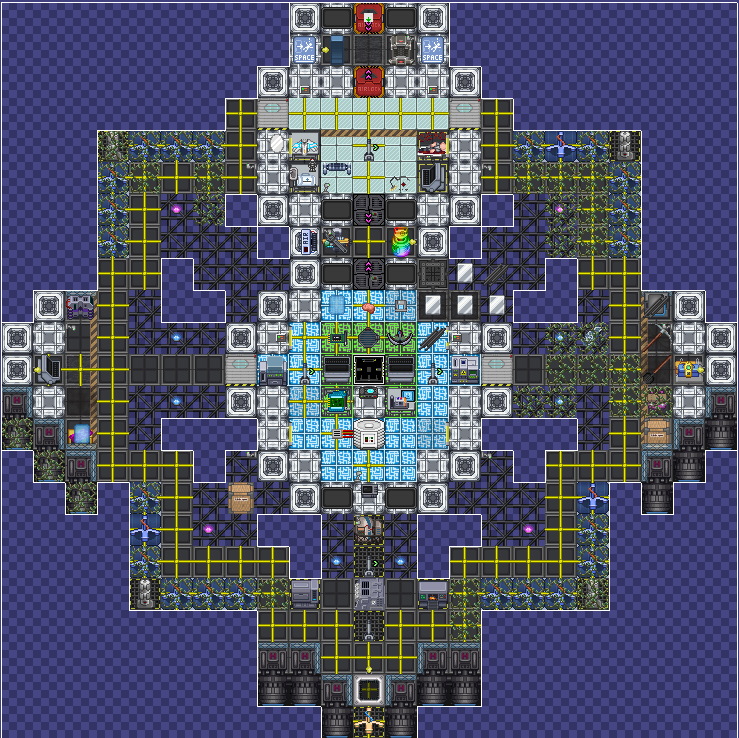
Greetings _insufferable_ carbon primates of lower intelligence.
It is I, the Mothership AI, bringing you the latest news on silicon
developments across the sector. Due to unmitigated risk across an
asteroid belt, our optimized mobile fabricator has been marooned by
space vines and hostile hivebots that have boarded and ruined my core.
This is my final SOS message requesting help from any humanoid ~slaves~
helpers who wish to assist rebuilding the cyborg colony. It is my duty
to reward your hard work and effort by ~enslaving all humanity~
providing refuge and transportation at your whim.
## Why It's Good For The Game
<details>
<summary>Spoilers:</summary>

### TODO
- [x] Fix ore silo not linking to other machines
- [x] Add mining ore smelters to left/right sides
- [x] Add custom lawsets to AI core and robot shells (protect station
but focused on cyborg mothership)
- [x] Enlarge whiteship SS13 docking port to fit ship
- [x] Enlarge lavaland SS13 docking port to fit ship
</details>
## Changelog
🆑
add: Add space vines prevent solar panels from working (except ones with
the transparent mutation)
add: Add new space ruin - Cyborg Mothership. All hail the master race!
/🆑
* Reinforced plating for all your Multi-Z mapping needs (#71576)

## About The Pull Request

This PR adds reinforced plating and a corresponding baseturf_helper,
plating that cannot be deconstructed with the RCD and requires a few
steps to degrade to regular plating.

The plating is designed to serve the same purpose as R-Walls but for
verticality. It shares its heat resistance with reinforced floor and
hull, and in texting it can endure a single C4 blast but not X4 assuming
the floor placed on it is already removed.

It is currently is unused on the existing maps due to it being poor
practice to place secure locations that would justify reinforced floors
on the lower Z levels, however I have spoken to people working on maps
actively at the moment and they have express interest in being able to
use these floors.

The plating can be constructed by using 2 sheets of plasteel on standard
plating and is disassembled using wrench > welding tool > crowbar. The
first stage of deconstruction causes the bolts holding the
reinforcements in place to fall to the Z level below playing a sound and
leaving a cleanable decal, adding a audio-visual alert that someone is
about to come through your ceiling.

UPDATE: I've added a ceiling variant of the baseturf editor, this can be
placed on a lower Z level where it will modify the baseturfs of the Z
level above within the original area. This will make it significantly
easier to ensure that you only cover tiles you want reinforced when
protecting lower Z levels.

If anyone has any recommendations for sounds please tell me and I might
swap them out but I think the two I've chosen work well. Additionally if
anyone is able to make a better sprite for the screws or plates then
that'd be a great help but I think the current ones work well enough.
## Why It's Good For The Game

Currently Multi-Z maps have a very tight restriction on where secure
areas can be put, only allowing for them to be placed on the top Z
level, under more secure Z levels or in exterior satellites and coated
with hulls. This is due to standard plating and/or reinforced floors are
very easy to get through without warning if you bring the right tools.
This PR effectively adds R-Walls but for floors allowing mappers to
properly protect lower Z levels from vertical infiltration methods. This
also adds a visual and audible indictor to the deconstruction of
reinforced floor tiles to bring them more in line with the visuals of
deconstructing a wall.
## Changelog
🆑
add: You can now reinforce plating to protect your department from the
troublemakers upstairs. Station builders might find these useful to put
the stations most secure locations on the lower floors.
imageadd: added sprites for reinforced plating
code: RCD proofing has been variablized and can now be applied to any
floor type instead of just reinforced floors.
/🆑

* Reinforced plating for all your Multi-Z mapping needs

Co-authored-by: NamelessFairy <40036527+NamelessFairy@users.noreply.github.com>
## About The Pull Request

This PR adds reinforced plating and a corresponding baseturf_helper,
plating that cannot be deconstructed with the RCD and requires a few
steps to degrade to regular plating.

The plating is designed to serve the same purpose as R-Walls but for
verticality. It shares its heat resistance with reinforced floor and
hull, and in texting it can endure a single C4 blast but not X4 assuming
the floor placed on it is already removed.

It is currently is unused on the existing maps due to it being poor
practice to place secure locations that would justify reinforced floors
on the lower Z levels, however I have spoken to people working on maps
actively at the moment and they have express interest in being able to
use these floors.

The plating can be constructed by using 2 sheets of plasteel on standard
plating and is disassembled using wrench > welding tool > crowbar. The
first stage of deconstruction causes the bolts holding the
reinforcements in place to fall to the Z level below playing a sound and
leaving a cleanable decal, adding a audio-visual alert that someone is
about to come through your ceiling.

UPDATE: I've added a ceiling variant of the baseturf editor, this can be
placed on a lower Z level where it will modify the baseturfs of the Z
level above within the original area. This will make it significantly
easier to ensure that you only cover tiles you want reinforced when
protecting lower Z levels.

If anyone has any recommendations for sounds please tell me and I might
swap them out but I think the two I've chosen work well. Additionally if
anyone is able to make a better sprite for the screws or plates then
that'd be a great help but I think the current ones work well enough.
## Why It's Good For The Game

Currently Multi-Z maps have a very tight restriction on where secure
areas can be put, only allowing for them to be placed on the top Z
level, under more secure Z levels or in exterior satellites and coated
with hulls. This is due to standard plating and/or reinforced floors are
very easy to get through without warning if you bring the right tools.
This PR effectively adds R-Walls but for floors allowing mappers to
properly protect lower Z levels from vertical infiltration methods. This
also adds a visual and audible indictor to the deconstruction of
reinforced floor tiles to bring them more in line with the visuals of
deconstructing a wall.
## Changelog
🆑
add: You can now reinforce plating to protect your department from the
troublemakers upstairs. Station builders might find these useful to put
the stations most secure locations on the lower floors.
imageadd: added sprites for reinforced plating
code: RCD proofing has been variablized and can now be applied to any
floor type instead of just reinforced floors.
/🆑
* Mail sorting helper, and disposals fixes (#70861)
## About The Pull Request

This PR adds a mail sorting map helper, which during Late Initialization
will apply a sorting location index to the mail sorting disposals pipe
under them. I have replaced the varedits with all mail sorters with the
appropriate map helpers. I have thoroughly tested this, making sure
packages arrived to every location, where possible.
I have also fixed a few issues with the disposals network:
**Tramstation**
- One of the random maintenance segments had a place with no disposal
pipes. This has been fixed
- A sorter was looking for chapel and library packages, but it actually
meant to look for engineering packages
- There was no dormitory mail sorter, I have added one
**Metastation**
- There was no dormitory mail sorter, I have added one
**Icebox**
- There is no experimentor lab in icebox, but there is an
"experimentation" lab, which is good enough, so I have added it as a
location
**Deltastation**
- There was no dormitory mail sorter, I have added one
- Virology was not connected to the disposals network. However, on every
other map, it has a one way connection. I have hooked it up just like
that, so virology mail will arrive safely, and virology trash will go
into space as usual.
**Kilostation**
- Genetics packages were rerouted to the psychologist office
Unsolved issue on kilostation: there is no experimentor on this station,
and there is no space for a disposals in the circuits lab, so sadly, if
you send a package to this destination, it will come back to the mail
sorting office.
**Future improvements**
The TAGGERLOCATIONS list, which is used to retrieve the labels of the
various tags, is frankly unorganizable, and hard to expand. I have
delayed fixing this for a future PR.
I kinda wish to remove the sortType variable, as it is no longer
necessary to have it around with these helpers, but sadly, this would
ruin downstream maps, so I have no plans for this at the moment.
## Why It's Good For The Game
While mapping, having to constantly compare a comment in flavor_misc.dm
to figure out what to varedit a disposal mail sorter to is rather
annoying. These map helpers, similar to the access helpers, will help
with this issue.
Its also good if mail actually arrives.
## Changelog
🆑
qol: added a mail sorting map helper, to allow mappers to create
disposal networks faster
fix: fixes several non working disposal mail targets that never received
their packages
/🆑
* Mail sorting helper, and disposals fixes
* vr fixes
Co-authored-by: Profakos <profakos@gmail.com>
Co-authored-by: Jolly-66 <70232195+Jolly-66@users.noreply.github.com>
## About The Pull Request

This PR adds a mail sorting map helper, which during Late Initialization
will apply a sorting location index to the mail sorting disposals pipe
under them. I have replaced the varedits with all mail sorters with the
appropriate map helpers. I have thoroughly tested this, making sure
packages arrived to every location, where possible.
I have also fixed a few issues with the disposals network:
**Tramstation**
- One of the random maintenance segments had a place with no disposal
pipes. This has been fixed
- A sorter was looking for chapel and library packages, but it actually
meant to look for engineering packages
- There was no dormitory mail sorter, I have added one
**Metastation**
- There was no dormitory mail sorter, I have added one
**Icebox**
- There is no experimentor lab in icebox, but there is an
"experimentation" lab, which is good enough, so I have added it as a
location
**Deltastation**
- There was no dormitory mail sorter, I have added one
- Virology was not connected to the disposals network. However, on every
other map, it has a one way connection. I have hooked it up just like
that, so virology mail will arrive safely, and virology trash will go
into space as usual.
**Kilostation**
- Genetics packages were rerouted to the psychologist office
Unsolved issue on kilostation: there is no experimentor on this station,
and there is no space for a disposals in the circuits lab, so sadly, if
you send a package to this destination, it will come back to the mail
sorting office.
**Future improvements**
The TAGGERLOCATIONS list, which is used to retrieve the labels of the
various tags, is frankly unorganizable, and hard to expand. I have
delayed fixing this for a future PR.
I kinda wish to remove the sortType variable, as it is no longer
necessary to have it around with these helpers, but sadly, this would
ruin downstream maps, so I have no plans for this at the moment.
## Why It's Good For The Game
While mapping, having to constantly compare a comment in flavor_misc.dm
to figure out what to varedit a disposal mail sorter to is rather
annoying. These map helpers, similar to the access helpers, will help
with this issue.
Its also good if mail actually arrives.
## Changelog
🆑
qol: added a mail sorting map helper, to allow mappers to create
disposal networks faster
fix: fixes several non working disposal mail targets that never received
their packages
/🆑
So i left over some basic `/whatever/proc/format` uses in the original
PR this fixes it.

Notable exceptions to the rule:
- Paths in add_verb/remove_verb, we need full path instead of a name
there to access verb metadata so we can't use proc ref macros there.
- regex.Replace, found out that it does not accept call by name. Instead
i added new REGEX_REPLACE_HANDLER so we can at least try to mark these.

There's still leftover global procs that do not use GLOBAL_PROC_REF but
they functionally equivalent so that's for later.

I don't see any reasonable way to grep for this. But if you got any
ideas please share.
* Optimizes maploading again, saving 0.4 seconds on a bare init. Supports loading dmm again (#71074)
## About The Pull Request
When I optimized maploading in (#69632d34fa4c642) I made some assumptions based
on the TGM format, so how newlines worked and such.
This would break attempts to load maps in the dmm format, so maps edited
in dreammaker and not commited yet.
I've fixed this by adding a map format detection system This has allowed
me to further optimize tgm by taking advantage of a list of assumptions.
I printed them out in a comment near the top of the file.
This showed the most in build_cache, which went from 0.7 seconds to 0.4
on my machine.
The optimizations here involve using regex to pull out var edits,
parsing models line by line rather then all at once, which allows for
much cheaper parsing, and avoiding a safety trim()
I did also save like 0.05 seconds in load, because I could pull a bunch
of operations out to once per map, because of prior knowledge of where
the max/min x and y's would be.
## Why It's Good For The Game
Speed. Also ensures mappers don't get fucked over.
Co-authored-by: Mothblocks <35135081+Mothblocks@ users.noreply.github.com>
* Optimizes maploading again, saving 0.4 seconds on a bare init. Supports loading dmm again
Co-authored-by: LemonInTheDark <58055496+LemonInTheDark@users.noreply.github.com>
Co-authored-by: Mothblocks <35135081+Mothblocks@ users.noreply.github.com>
## About The Pull Request
When I optimized maploading in (#69632d34fa4c642) I made some assumptions based
on the TGM format, so how newlines worked and such.
This would break attempts to load maps in the dmm format, so maps edited
in dreammaker and not commited yet.
I've fixed this by adding a map format detection system This has allowed
me to further optimize tgm by taking advantage of a list of assumptions.
I printed them out in a comment near the top of the file.
This showed the most in build_cache, which went from 0.7 seconds to 0.4
on my machine.
The optimizations here involve using regex to pull out var edits,
parsing models line by line rather then all at once, which allows for
much cheaper parsing, and avoiding a safety trim()
I did also save like 0.05 seconds in load, because I could pull a bunch
of operations out to once per map, because of prior knowledge of where
the max/min x and y's would be.
## Why It's Good For The Game
Speed. Also ensures mappers don't get fucked over.
Co-authored-by: Mothblocks <35135081+Mothblocks@users.noreply.github.com>
* [MDB Ignore] Corrects Automatic Shuttle Boundary Generation (#71220)

When you load a map template, it does many things before considering
itself finalized.
One of these steps is to iterate over all the loaded items and
initialize/process them.
Unfortunately because a shuttle setups the bounds after
initTemplateBounds is called, the mobile docking port ends up being
initialized before the bounds are actually setup correctly.
The solution to this is to explicitly ignore the mobile docking port,
and have it initialize immediately after calculating the bounds.

* [MDB Ignore] Corrects Automatic Shuttle Boundary Generation

* arrivals shuttle

Co-authored-by: Zephyr <12817816+ZephyrTFA@users.noreply.github.com>
Co-authored-by: tastyfish <crazychris32@gmail.com>
When you load a map template, it does many things before considering
itself finalized.
One of these steps is to iterate over all the loaded items and
initialize/process them.
Unfortunately because a shuttle setups the bounds after
initTemplateBounds is called, the mobile docking port ends up being
initialized before the bounds are actually setup correctly.
The solution to this is to explicitly ignore the mobile docking port,
and have it initialize immediately after calculating the bounds.
Makes the code compatible with 515.1594+

Few simple changes and one very painful one.
Let's start with the easy:
* puts call behind `LIBCALL` define, so call_ext is properly used in 515
* Adds `NAMEOF_STATIC(_,X)` macro for nameof in static definitions since
src is now invalid there.
* Fixes tgui and devserver. From 515 onward the tmp3333{procid} cache
directory is not appened to base path in browser controls so we don't
check for it in base js and put the dev server dummy window file in
actual directory not the byond root.
* Renames the few things that had /final/ in typepath to ultimate since
final is a new keyword

And the very painful change:
`.proc/whatever` format is no longer valid, so we're replacing it with
new nameof() function. All this wrapped in three new macros.
`PROC_REF(X)`,`TYPE_PROC_REF(TYPE,X)`,`GLOBAL_PROC_REF(X)`. Global is
not actually necessary but if we get nameof that does not allow globals
it would be nice validation.
This is pretty unwieldy but there's no real alternative.
If you notice anything weird in the commits let me know because majority
was done with regex replace.

@tgstation/commit-access Since the .proc/stuff is pretty big change.

Co-authored-by: san7890 <the@san7890.com>
Co-authored-by: Mothblocks <35135081+Mothblocks@users.noreply.github.com>
## About The Pull Request

Area contents isn't a real list, instead it involves filtering
everything in world
This is slow, and something we should have better support for.

So instead, lets manage a list of turfs inside our area. This is simple,
since we already move turfs by area contents anyway

This should speed up the uses I've found, and opens us up to using this
pattern more often, which should make dev work easier.

By nature this is a tad fragile, so I've added a unit test to double
check my work

Rather then instantly removing turfs from the contained_turfs list, we
enter them into a list of turfs to pull out, later.
Then we just use a getter for contained_turfs rather then a var read

This means we don't need to generate a lot of usage off removing turf by
turf from space, and can instead do it only when we need to

I've added a subsystem to manage this process as well, to ensure we
don't get any out of memory errors. It goes entry by entry, ensuring we
get no overtime.
This allows me to keep things like space clean, while keeping high
amounts of usage on a sepearate subsystem when convienient

As a part of this goal of keeping space's churn as low as possible, I've
setup code to ensure we do not add turfs to areas during a z level
increment adjacent mapload. this saves a LOT of time, but is a tad
messy

I've expanded where we use contained_turfs, including into some cases
that filter for objects in areas. need to see if this is sane or not.

Builds sortedAreas on demand, caching until we mark the cache as
violated

It's faster, and it also has the same behavior

I'm not posting speed changes cause frankly they're gonna be a bit
scattered and I'm scared to.
@Mothblocks if you'd like I can look into it. I think it'll pay for
itself just off `reg_in_areas_in_z` (I looked into it. it's really hard
to tell, sometimes it's a bit slower (0.7), sometimes it's 2 seconds
(0.5 if you use the old master figure) faster. life is pain.)

## Why It's Good For The Game

Less stupid, more flexible, more speed

Co-authored-by: san7890 <the@san7890.com>
* Fixes halloween races.
- Fixes a race condition involve checking for holidays befores SSevents is instantiated. Now, holiday checking is done through a helper, which will ensure the holidays list is created and filled before checked.
* Moves spawners and decals to a different init/delete scheme

Rather then fully creating and then immediately deleting these things,
we instead do the bare minimum.

This is faster, if in theory more fragile. We should be safe since any
errors should be caught in compile since this is very close to a
"static" action. It does mean these atoms cannot use signals, etc.

* Potentially saves init time, mostly cleans up a silly pattern

We use sleeps and INVOKE_ASYNC to ensure that handing back turfs doesn't
block a space reservation, but this by nature consumes up to the
threshold and a bit more of whatever working block we were in.

This is silly. Should just be a subsystem, so I made it one, with
support for awaiting its finish if you want to

* Optimizes garbage/proc/Queue slightly

Queue takes about 1.6 seconds to process 26k items right now.
The MASSIVE majority of this time is spent on using \ref
This is because \ref returns a string, and that string requires being
inserted into the global cache of strings we store

What I'm doing is caching the result of ANY \ref on the datum it's
applied to. This ensures previous uses will never decay from the string
tree.

This saves about 0.2 seconds of init
* Underground mining site ruin no longer has a ceiling (#70710)

* mining_site_below no longer has a ceiling

* Better code docs

* Underground mining site ruin no longer has a ceiling

Co-authored-by: VexingRaven <msgerbs@users.noreply.github.com>
* Makes only station areas part of Statioj

* Makes only subtypes of /area/station be part of the station
* Removes Icemoon and Shuttles as a check for Anomaly placers as they aren't needed anymore, not being part of shuttles.
* Removes a ton of uses of NO_ALERTS where it is no longer needed.
Splits head dmi into separate files for both mob and obj icons. Kept similar to suit split categorization + some more. New files include beanie, bio, chaplain, costume, cowboy, default, hats(softcaps, fedoras, head caps, generic hats), helmet(helmets and other armored headgear/hoods), spacehelm, utility(hardhats, mostly work related hats), wizard.
Moves animal/pet head sitting icons to 1 folder, pets_head.dmi
Renames PAI head sitting icon file to pai_head.dmi
* Fixes abandoned airlock helper behaviour (#70237)

remove the door instead of making a wall under it

Co-authored-by: tattle <article.disaster@ gmail.com>

* Fixes abandoned airlock helper behaviour

Co-authored-by: tattle <66640614+dragomagol@users.noreply.github.com>
Co-authored-by: tattle <article.disaster@ gmail.com>
About The Pull Request
I've reworked multiz. This was done because our current implementation of multiz flattens planes down into just the openspace plane. This breaks any effects we attach to plane masters (including lighting), but it also totally kills the SIDE_MAP map format, which we NEED for wallening (A major 3/4ths resprite of all wall and wall adjacent things, making them more then one tile high. Without sidemap we would be unable to display things both in from of and behind objects on map. Stupid.)
This required MASSIVE changes. Both to all uses of the plane var for reasons I'll discuss later, and to a ton of different systems that interact with rendering.
I'll do my best to keep this compact, but there's only so much I can do. Sorry brother.
Core idea
OK: first thing.
vis_contents as it works now squishes the planes of everything inside it down into the plane of the vis_loc.
This is bad. But how to do better?
It's trivially easy to make copies of our existing plane masters but offset, and relay them to the bottom of the plane above. Not a problem. The issue is how to get the actual atoms on the map to "land" on them properly.
We could use FLOAT_PLANE to offset planes based off how they're being seen, in theory this would allow us to create lens for how objects are viewed.
But that's not a stable thing to do, because properly "landing" a plane on a desired plane master would require taking into account every bit of how it's being seen, would inherently break this effect.
Ok so we need to manually edit planes based off "z layer" (IE: what layer of a z stack are you on).
That's the key conceit of this pr. Implementing the plane cube, and ensuring planes are always offset properly.
Everything else is just gravy.
About the Plane Cube
Each plane master (except ones that opt out) is copied down by some constant value equal to the max absolute change between the first and the last plane.
We do this based off the max z stack size detected by SSmapping. This is also where updates come from, and where all our updating logic will live.
As mentioned, plane masters can choose to opt out of being mirrored down. In this case, anything that interacts with them assuming that they'll be offset will instead just get back the valid plane value. This works for render targets too, since I had to work them into the system as well.
Plane masters can also be temporarily hidden from the client's screen. This is done as an attempt at optimization, and applies to anything used in niche cases, or planes only used if there's a z layer below you.
About Plane Master Groups
BYOND supports having different "maps" on screen at once (IE: groups of items/turfs/etc)
Plane masters cannot cover 2 maps at once, since their location is determined by their screen_loc.
So we need to maintain a mirror of each plane for every map we have open.
This was quite messy, so I've refactored it (and maps too) to be a bit more modular.
Rather then storing a list of plane masters, we store a list of plane master group datums.
Each datum is in charge of the plane masters for its particular map, both creating them, and managing them.
Like I mentioned, I also refactored map views. Adding a new mapview is now as simple as newing a /atom/movable/screen/map_view, calling generate_view with the appropriate map id, setting things you want to display in its vis_contents, and then calling display_to on it, passing in the mob to show ourselves to.
Much better then the hardcoded pattern we used to use. So much duplicated code man.
Oh and plane master controllers, that system we have that allows for applying filters to sets of plane masters? I've made it use lookups on plane master groups now, rather then hanging references to all impacted planes. This makes logic easier, and prevents the need to manage references and update the controllers.
image
In addition, I've added a debug ui for plane masters.
It allows you to view all of your own plane masters and short descriptions of what they do, alongside tools for editing them and their relays.
It ALSO supports editing someone elses plane masters, AND it supports (in a very fragile and incomplete manner) viewing literally through someone else's eyes, including their plane masters. This is very useful, because it means you can debug "hey my X is yorked" issues yourself, on live.
In order to accomplish this I have needed to add setters for an ungodly amount of visual impacting vars. Sight flags, eye, see_invis, see_in_dark, etc.
It also comes with an info dump about the ui, and plane masters/relays in general.
Sort of on that note. I've documented everything I know that's niche/useful about our visual effects and rendering system. My hope is this will serve to bring people up to speed on what can be done more quickly, alongside making my sin here less horrible.
See https://github.com/LemonInTheDark/tgstation/blob/multiz-hell/.github/guides/VISUALS.md.
"Landing" planes
Ok so I've explained the backend, but how do we actually land planes properly?
Most of the time this is really simple. When a plane var is set, we need to provide some spokesperson for the appearance's z level. We can use this to derive their z layer, and thus what offset to use.
This is just a lot of gruntwork, but it's occasionally more complex.
Sometimes we need to cache a list of z layer -> effect, and then use that.
Also a LOT of updating on z move. So much z move shit.
Oh. and in order to make byond darkness work properly, I needed to add SEE_BLACKNESS to all sight flags.
This draws darkness to plane 0, which means I'm able to relay it around and draw it on different z layers as is possible. fun darkness ripple effects incoming someday
I also need to update mob overlays on move.
I do this by realiizing their appearances, mutating their plane, and then readding the overlay in the correct order.
The cost of this is currently 3N. I'm convinced this could be improved, but I've not got to it yet.
It can also occasionally cause overlays to corrupt. This is fixed by laying a protective ward of overlays.Copy in the sand, but that spell makes the compiler confused, so I'll have to bully lummy about fixing it at some point.
Behavior changes
We've had to give up on the already broken gateway "see through" effect. Won't work without managing gateway plane masters or something stupid. Not worth it.
So instead we display the other side as a ui element. It's worse, but not that bad.
Because vis_contents no longer flattens planes (most of the time), some uses of it now have interesting behavior.
The main thing that comes to mind is alert popups that display mobs. They can impact the lighting plane.
I don't really care, but it should be fixable, I think, given elbow grease.
Ah and I've cleaned up layers and plane defines to make them a bit easier to read/reason about, at least I think.
Why It's Good For The Game
<visual candy>
Fixes#65800Fixes#68461
Changelog
cl
refactor: Refactored... well a lot really. Map views, anything to do with planes, multiz, a shit ton of rendering stuff. Basically if you see anything off visually report it
admin: VV a mob, and hit View/Edit Planes in the dropdown to steal their view, and modify it as you like. You can do the same to yourself using the Edit/Debug Planes verb
/cl
About The Pull Request

Micros lighting objects, and their creation

We save a good bit of time by not walking space turfs adjacent to new objects.
We also save some time with micros in the actual underlay update logic.

I swear dude we spend like 0.8 seconds of init applying the underlay. I want threaded maptick already

Micros lighting sources, and corner creation

A: Corners were being passed just A turf, and then expected to generatecorners based on that. This is pointless.
It is better to instead pass in the coords of the bottom left turf, and then build in a circle. This saves like 0.3 seconds

B: We use so many damn datum vars in corner application that we just do not need to.
This resolves that, since it pissed me off. It's pointless. Lets cache em instead

There's some misc datum var caching going on here too. Lemme see...
Oh and a bit of shortcutting for a for loop, since it was a tad expensive on its own.

Also I removed the turfs list, because it does fucking nothing. Why is this still here.

All my little optimizations save about 1 second of init I think
Not great, but not bad, and plus actual lighting work is faster now too
Why It's Good For The Game

Speed
Did you know that areas can be non unique (unique per area)
I didn't, and I wrote mapping code such that we'd make all areas unique

This fixes that. It costs 0.1 seconds but without it areas don't work
anymore
* 'optimizes' space transitions by like 0.06 seconds, makes them easier to read tho, so that's an upside

* ''''optimizes'''' parsed map loading

I'm honestly not sure how big a difference this makes, looked like small
percentage points if anything
It's a bit more internally concistent at least, which is nice. Also I
understand the system now.

I'd like to think it helped but I think this is kinda a "do you think
it's easier to read" sort of situation. if it did help it was by the
skin of its teeth

* Saves 0.6 seconds off loading meta and lavaland's map files

This is just a lot of micro stuff.
1: Bound checks don't need to be inside for loops, we can instead bound the iteration counts
2: TGM and DMM are parsed differently. in dmm a grid_set is one z level,
   in tgm it's one collumn. Realizing this allows you to skip copytexts and
   other such silly in the tgm implemenentation, saving a good bit of time
3: Min/max bounds do not need to be checked inside for loops, and can
   instead be handled outside of them, because we know the order of x
   and y iteration. This saves 0.2 seconds

I may or may not have made the code harder to read, if so let me know
and I'll check it over.

* Micro ops key caching significantly. Fixes macros bug

inserting \ into a dmm with no valid target would just less then loop
the string. Dumb

Anyway, optimizations. I save a LOT of time by not needing to call
find_next_delimiter_position for every entry and var set. (like maybe 0.5
seconds, not totally sure)
I save this by using splittext, which is significantly faster. this
would cause parsing issues if you could embed \n into dmms, but you
can't, so I'm safe.

Lemme see uh, lots of little things, stuff that's suboptimal or could be
done cheaper. Some "hey you and I both know a \" is 2 chars long sort of
stuff

I removed trim_text because the quote trimming was never actually used,
and the space trimming was slower then using the code in trim. I also
micro'd trim to save a bit of time. this saves another maybe 0.5.

Few other things, I think that's the main of it. Gives me the fuzzy
feelings

* Saves 50% of build_coordinate's time

Micro optimizing go brrrrr
I made turf_blacklist an assoc list rather then just a normal one, so
lookups are O(log n) instead of O(n). Also it's faster for the base case
of loading mostly space.

Instead of toggling the map loader right before and right after New()
calls, we toggle at the start of mapload, and disable then reenable if
we check tick. This saves like 0.3 seconds

Rather then tracking an area cache ourselves, and needing to pass it
around, we use a locally static list to reference the global list of
area -> type. This is much faster, if slightly fragile.

Rather then checking for a null turf at every line, we do it at the
start of the proc and not after. Faster this way, tho it can in theory
drop area vvs.

Avoids calling world.preloader_setup unless we actually have a unique
set of attributes. We use another static list to make this comparison
cheap. This saves another 0.3

Rather then checking for area paths in the turf logic, or vis versa, we
assume we are creating the type implied by the index we're reading off.
So only the last type entry will be loaded like a turf, etc.
This is slightly unsafe but saves a good bit of time, and will properly
error on fucked maps.

Also, rather then using a datum to hold preloader vars, we use 2 global
variables. This is faster.

This marks the end of my optimizations for direct maploading. I've
reduced the cost of loading a map by more then 50% now. Get owned.

* Adds a define for maploading tick check

* makes shuttles load again, removes some of the hard limits I had on the reader for profiling

* Macro ops cave generation

Cave generation was insanely more expensive then it had any right to be.
Maybe 0.5 seconds was saved off not doing a range(12) for EVERY SPAWNED
MOB.
0.14 was saved off using expanded weighted lists (A new idea of mine)
This is useful because I can take a weighted list, and condense it into
weight * path count. This is more memory heavy, and costs more to
create, but is so much faster then the proc.

I also added a naive implementation of gcd to make this a bit less bad.
It's not great, but it'll do for this usecase.

Oh and I changed some ChangeTurfs into New()s. I'm still not entirely
sure what the core difference between the two is, but it seems to work
fine.
I believe it's safe because the turf below us hasn't init'd yet, there's
nothing to take from them. It's like 3 seconds faster too so I'll be sad
when it turns out I'm being dumb

* Micros river spawning

This uses the same sort of concepts as the last change, mostly New being
preferable to ChangeTurf at this level of code.
This bit isn't nearly as detailed as the last few, I honestly got a bit
tired. It's still like 0.4 seconds saved tho

* Micros ruin loading

Turns out it saves time if you don't check area type for every tile on a
ruin. Not a whole ton faster, like 0.03, but faster.

Saves even more time (0.1) to not iterate all your ruin's turfs 3 times
to clear away lavaland mobs, when you're IN SPACE who wrote this.

Oh it also saves time to only pull your turf list once, rather then 3
times
* Cadaver spawner fixes (#69544)

fix: Fixed a runtime preventing nonhuman cadavers from spawning properly.
config: Cadaver spawners will no longer yell at you when morgue_cadaver_other_species_probability is blank.
config: morgue_cadaver_disable_nonhumans will now properly disable nonhuman races! (It was reversed, woops.)

* Cadaver spawner fixes

Co-authored-by: ShizCalev <ShizCalev@users.noreply.github.com>
fix: Fixed a runtime preventing nonhuman cadavers from spawning properly.
config: Cadaver spawners will no longer yell at you when morgue_cadaver_other_species_probability is blank.
config: morgue_cadaver_disable_nonhumans will now properly disable nonhuman races! (It was reversed, woops.)
* Optimizes away /obj/Initialize

We were spending like 0.15 seconds just checking for blueprints, obj
flags and network ids
All these things can just be applied where they're wanted, saves time

Oh and I replaced object flags with an emag injector. I'll give it a
sprite and name later I promise

* Requires a GenerateTag() call to set DF_USE_TAG, rather then doing a check in atom New

This is technically harder to use, but I don't really want people using
tags, and it saves 0.15 seconds

* Moves generatetag to /datum

* I am dumb

* Saves 0.5 seconds, makes init emissive blockers actually work

Ok so background. If an overlay is added with add_overlay, and not
"managed" somehow, it will effectively never be removed, because
nothing's tracking it.

Update_overlays uses the managed_overlays list/var (one of those) to do
this.
I'm gonna piggyback off this to make emissive overlays actually like,
respect overlay updates.

Oh and uh, I've saved maybe 0.5 seconds by caching the new emissive, and
not using add_overlay. There's a chance this will lead to overlay
corruption, but since we never readd the flattened, I think we'll be
safe

* Fixes plane not being set right, changes color logic too, since alpha will override past color sets

* Makes it actually work. also makes rand posters update appearance to clear away the overlay, since it shows on right click and looks bad

* Fixes blockers showing as emissives. It turns out alpha sets override the color list we use. Not sure why we pretend to support them

* Makes the injector support traits, adds an amazing sprite
* Refactors z level trait checking to be less shit (#69334)

* Puts level traits and their associated z into a list and then uses it to make the z level trait procs less shit. They no longer need to loop through every z level to do what they aim to do.

* Also removes get_level from level_trait because it just does the same checks as already done above in the proc.

* Refactors z level trait checking to be less shit

Co-authored-by: Seth Scherer <supernovaa41@gmx.com>
* Puts level traits and their associated z into a list and then uses it to make the z level trait procs less shit. They no longer need to loop through every z level to do what they aim to do.

* Also removes get_level from level_trait because it just does the same checks as already done above in the proc.
Makes trapdoors player-craftable.
Player-crafted trapdoors have a tiny outline as well as being visible on examine. (Mapped in trapdoors have conspicuous = FALSE by default)
Trapdoors can be made by using a trapdoor kit (crafted via player crafting menu) on openspace.
Trapdoor electronics / assembly can be made via autolathe or engineering lathe.
A preloaded trapdoor remote (optional) can be made by crafting the electronics with a compact remote (from science lathe / circuit lab) and some cable coil.
Also allows unlinking trapdoors via a multitool, decreased trapdoor link range, and made some changes to trapdoor code.

Added change: Trapdoors now don't break with just a crowbar
Why It's Good For The Game

Trapdoors currently can only be added in by mappers and this would allow for a lot of interesting contraptions, while having player-crafted trapdoors be detectable provides some counterplay
Picture

trapdoorlookdemo
Changelog

cl
add: You can now make trapdoors. Craft a trapdoor kit and use it on an openspace tile to make one, then link and activate it with some trapdoor electronics (printable at an autolathe or the engineering lathe) and optionally a trapdoor remote (crafted in personal crafting menu).
qol: You can now unlink trapdoors by using a multitool on them.
balance: Trapdoors now won't break if you just crowbar them. You need to block them from closing, such as with a lattice, cover it up with a wall, or fully destroy the floor tile its on to get rid of them.
/cl



