 fd19f6d5a0
## About The Pull Request Now comes with a Hackmd: https://hackmd.io/ImTe5FLeTgmI7spTWKBaFQ?view In-game screenshots: 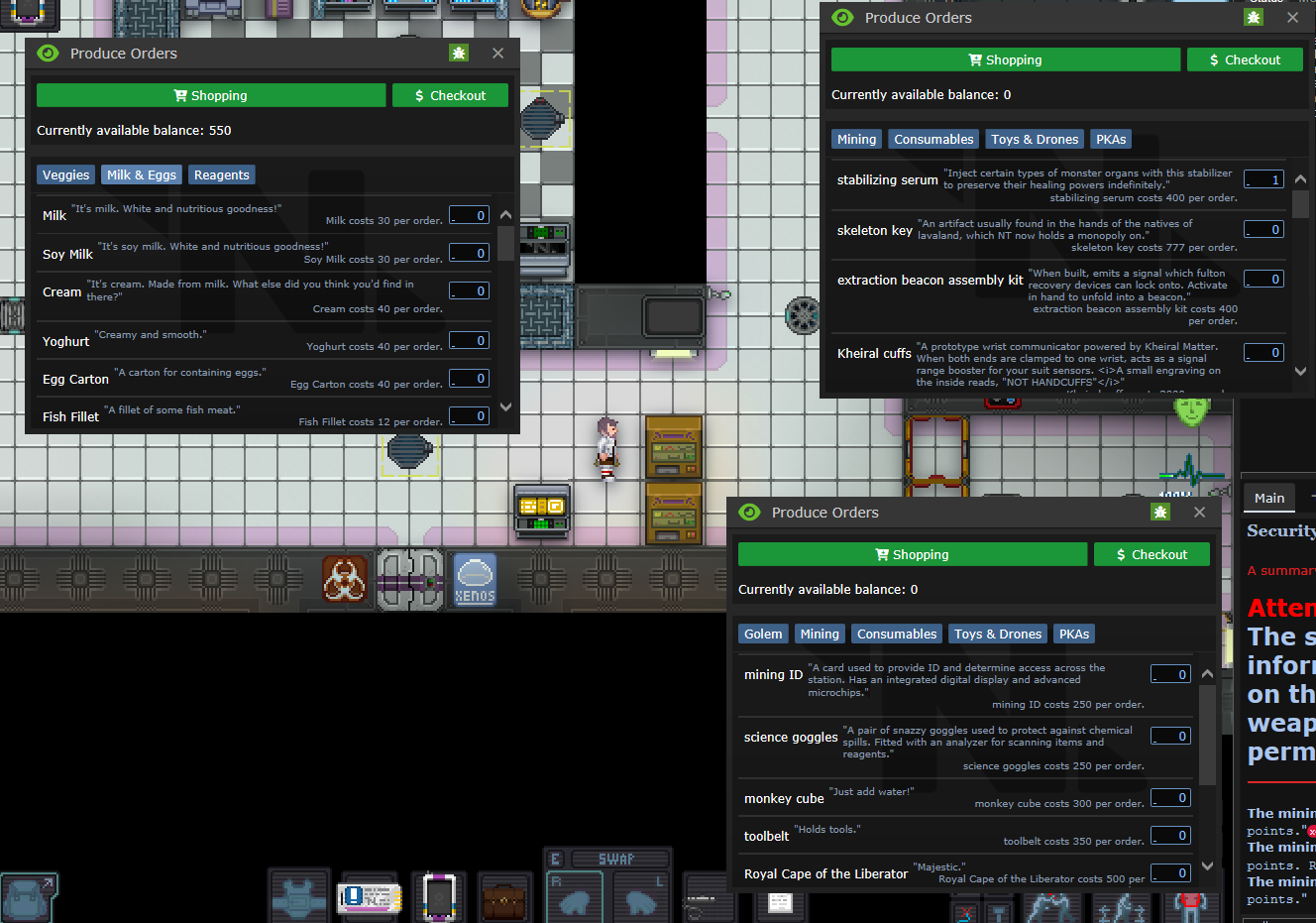 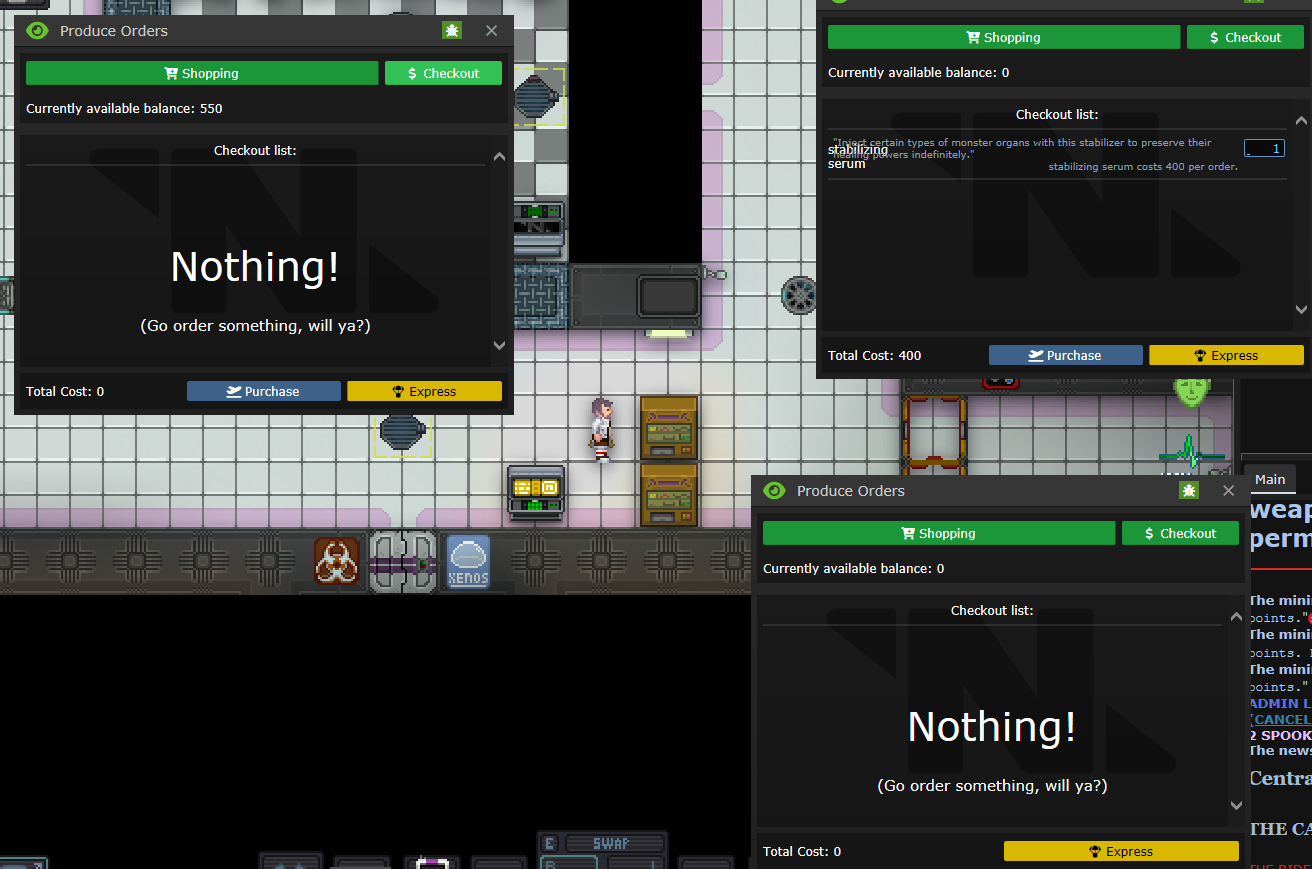 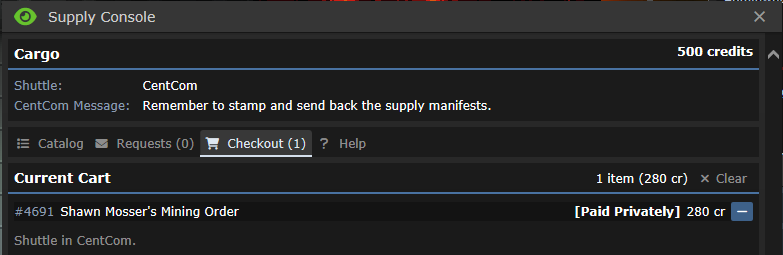 Removes the old Mining vendor console and all its bad code. Instead, the chef produce console was generalized and a NEW mining vendor is a subtype of it. If they try to Express this console, it will be 1.5x the mining points (compared to 2x for the Chef produce console atm), so it is technically possible, but it is still better to order it through Cargo. Different to the Kitchen crate, this one is a private order by the Shaft Miner, using mining points instead of Credits. Cargo CAN emitter it open, but I think that's an acceptable risk with all crates. As shown in the screenshot, Cargo will immediately know who ordered the items so knows who to call to pick it up when needed. This also means Shaft Miner's vendor is now categorized somewhat. I tried my best to make sense out of it but some items really don't make sense (laser pointer, soap...) I split the different sections of orderable items into different files for better management, and de-hardcoded it and its TGUI to make it easier for anyone who wants to add more to it. I also made the produce console use paths and added ways 'categories' to produce consoles, which indicates which sections you should and shouldn't be allowed to see. https://github.com/tgstation/tgstation/pull/71007 already did part of this but it isn't merged yet so :/ Free golems are mostly unaffected by this. Their console only works in express mode and doesn't increase the prices for it. The only downside is the cooldown. I still have some things to finish on this PR so it'll be left as draft until at least tomorrow. ## Why It's Good For The Game https://hackmd.io/ImTe5FLeTgmI7spTWKBaFQ?view 1. A large problem currently with Miners is that they don't interact with the station, this will at least help integrate them more into their own department, by making the cost of their equipment cheaper if they bother to actually go through Cargo for their gear. 2. It also means that a non functional Cargo would affect Shaft Miners too, and as they have access to the shuttle, maybe we can expect some Miners to pick up the slack if needed. 3. The old mining vendor was the ONLY vendor in the game that had infinite stock. It doesn't need a refill or anything like any other vendor, and every other vendor uses credits, mining points is just shaft miner credits. Why are they an exception? At least being ordered through the shuttle makes sense. 4. It opens the QM being able to see easier what Miners are doing, and prevents miners from hiding on Lavaland to do nothing but hunt fauna if they were meant to be demoted or something by the QM. Basically, gives the QM more control over the people working in their department. ## Changelog 🆑 add: Shaft Miner's equipment vendor now orders their equipment through the Cargo shuttle, though you can spend 1.5x the points to express it, making it a Mining version of the Chef's produce console, with a weakened express tax. /🆑



Unit Tests
What is unit testing?
Unit tests are automated code to verify that parts of the game work exactly as they should. For example, a test to make sure that the amputation surgery actually amputates the limb. These are ran every time a PR is made, and thus are very helpful for preventing bugs from cropping up in your code that would've otherwise gone unnoticed. For example, would you have thought to check that beach boys would still work the same after editing pizza? If you value your time, probably not.
On their most basic level, when UNIT_TESTS is defined, all subtypes of /datum/unit_test will have their Run proc executed. From here, if Fail is called at any point, then the tests will report as failed.
How do I write one?
- Find a relevant file.
All unit test related code is in code/modules/unit_tests. If you are adding a new test for a surgery, for example, then you'd open surgeries.dm. If a relevant file does not exist, simply create one in this folder, then #include it in _unit_tests.dm.
- Create the unit test.
To make a new unit test, you simply need to define a /datum/unit_test.
For example, let's suppose that we are creating a test to make sure a proc square correctly raises inputs to the power of two. We'd start with first:
/datum/unit_test/square/Run()
This defines our new unit test, /datum/unit_test/square. Inside this function, we're then going to run through whatever we want to check. Tests provide a few assertion functions to make this easy. For now, we're going to use TEST_ASSERT_EQUAL.
/datum/unit_test/square/Run()
    TEST_ASSERT_EQUAL(square(3), 9, "square(3) did not return 9")
    TEST_ASSERT_EQUAL(square(4), 16, "square(4) did not return 16")
As you can hopefully tell, we're simply checking if the output of square matches the output we are expecting. If the test fails, it'll report the error message given as well as whatever the actual output was.
- Run the unit test
Open code/_compile_options.dm and uncomment the following line.
//#define UNIT_TESTS //If this is uncommented, we do a single run though of the game setup and tear down process with unit tests in between
Then, run tgstation.dmb in Dream Daemon. Don't bother trying to connect, you won't need to. You'll be able to see the outputs of all the tests. You'll get to see which tests failed and for what reason. If they all pass, you're set!
How to think about tests
Unit tests exist to prevent bugs that would happen in a real game. Thus, they should attempt to emulate the game world wherever possible. For example, the quick swap sanity test emulates a real scenario of the bug it fixed occurring by creating a character and giving it real items. The unrecommended alternative would be to create special test-only items. This isn't a hard rule, the reagent method exposure tests create a test-only reagent for example, but do keep it in mind.
Unit tests should also be just that--testing units of code. For example, instead of having one massive test for reagents, there are instead several smaller tests for testing exposure, metabolization, etc.
The unit testing API
You can find more information about all of these from their respective doc comments, but for a brief overview:
/datum/unit_test - The base for all tests to be ran. Subtypes must override Run(). New() and Destroy() can be used for setup and teardown. To fail, use TEST_FAIL(reason).
/datum/unit_test/proc/allocate(type, ...) - Allocates an instance of the provided type with the given arguments. Is automatically destroyed when the test is over. Commonly seen in the form of var/mob/living/carbon/human/human = allocate(/mob/living/carbon/human/consistent).
TEST_FAIL(reason) - Marks a failure at this location, but does not stop the test.
TEST_ASSERT(assertion, reason) - Stops the unit test and fails if the assertion is not met. For example: TEST_ASSERT(powered(), "Machine is not powered").
TEST_ASSERT_NOTNULL(a, message) - Same as TEST_ASSERT, but checks if !isnull(a). For example: TEST_ASSERT_NOTNULL(myatom, "My atom was never set!").
TEST_ASSERT_NULL(a, message) - Same as TEST_ASSERT, but checks if isnull(a). If not, gives a helpful message showing what a was. For example: TEST_ASSERT_NULL(delme, "Delme was never cleaned up!").
TEST_ASSERT_EQUAL(a, b, message) - Same as TEST_ASSERT, but checks if a == b. If not, gives a helpful message showing what both a and b were. For example: TEST_ASSERT_EQUAL(2 + 2, 4, "The universe is falling apart before our eyes!").
TEST_ASSERT_NOTEQUAL(a, b, message) - Same as TEST_ASSERT_EQUAL, but reversed.
TEST_FOCUS(test_path) - Only run the test provided within the parameters. Useful for reducing noise. For example, if we only want to run our example square test, we can add TEST_FOCUS(/datum/unit_test/square). Should never be pushed in a pull request--you will be laughed at.
Final Notes
- Writing tests before you attempt to fix the bug can actually speed up development a lot! It means you don't have to go in game and folllow the same exact steps manually every time. This process is known as "TDD" (test driven development). Write the test first, make sure it fails, then start work on the fix/feature, and you'll know you're done when your tests pass. If you do try this, do make sure to confirm in a non-testing environment just to double check.
- Make sure that your tests don't accidentally call RNG functions like
prob. Since RNG is seeded during tests, you may not realize you have until someone else makes a PR and the tests fail! - Do your best not to change the behavior of non-testing code during tests. While it may sometimes be necessary in the case of situations such as the above, it is still a slippery slope that can lead to the code you're testing being too different from the production environment to be useful.